
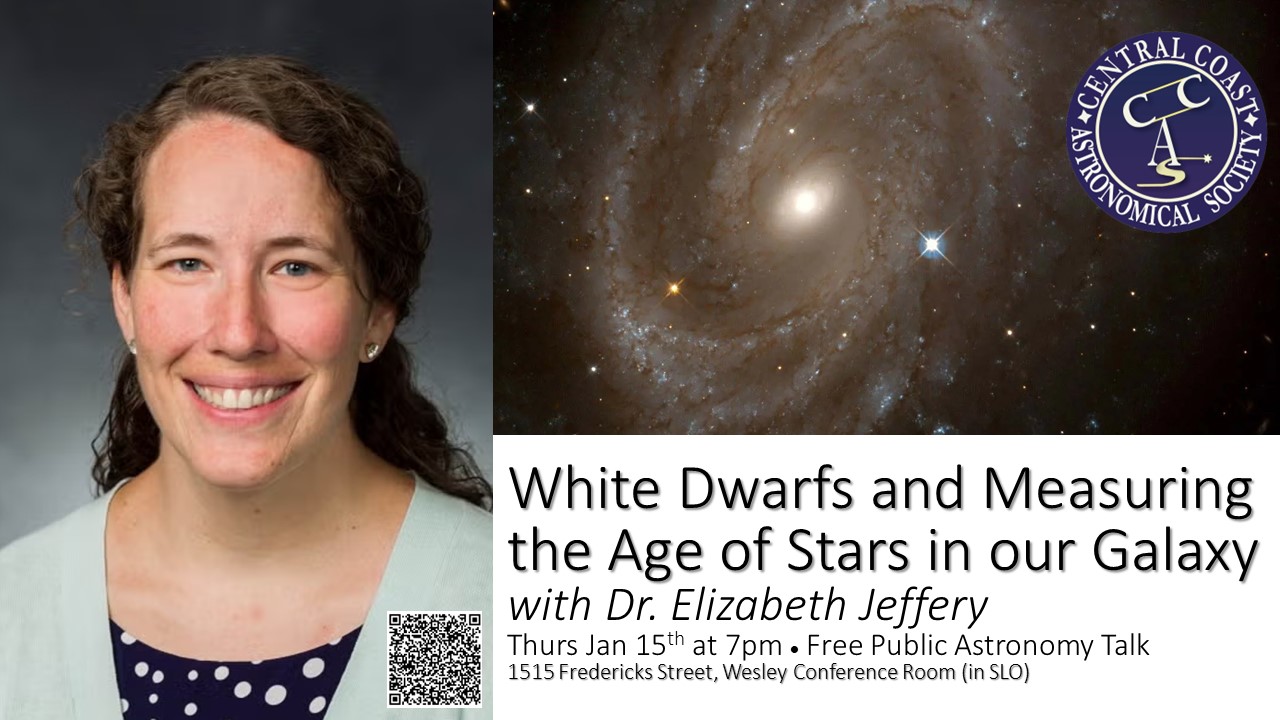
We are pleased to welcome Elizabeth Jeffery, Assistant Professor of Physics at California Polytechnic State University, for a talk on white dwarf stars and what they reveal about the age of stars in our galaxy.
Dr. Jeffery’s research focuses on white dwarf stars — the dense remnants left behind after Sun-like stars reach the end of their lives. By studying white dwarfs, astronomers can estimate the ages of stellar populations in the Milky Way, helping to build a timeline of our galaxy’s history. At Cal Poly, Dr. Jeffery leads undergraduate research projects centered on white dwarf stars and stellar populations.
Thursday, January 15th at 7pm
at 1515 Fredericks, San Luis Obispo
Dr. Elizabeth Jeffery is an astronomer and teaches physics and astronomy classes at Cal Poly. She completed her PhD at the University of Texas at Austin. Following graduate school she was a post doc researcher at the Space Telescope Science Institute in Baltimore. She has used telescopes in Texas, Arizona, Chile, and the Hubble Space Telescope to accomplish her research of studying the evolution and fundamental properties of stars. In her free time she enjoys traveling and spending time with her husband and three children.
This will be a fascinating evening for anyone curious about how stars live and die, how astronomers decode starlight, or how Cal Poly students are contributing to active astrophysical research. All are welcome to attend.
A white dwarf is the small, incredibly dense core left behind after a star like our Sun reaches the end of its life. When a medium-sized star runs out of fuel, it sheds its outer layers into space, creating a glowing shell of gas. What remains at the center is the white dwarf.
Despite being about the size of Earth, a white dwarf contains roughly the same mass as the Sun. This makes it extremely dense — a teaspoon of white dwarf material would weigh tons on Earth. It no longer produces energy through nuclear fusion. Instead, it shines because of leftover heat, slowly cooling over billions of years.
White dwarfs are important to astronomers because they tell us about the future of stars (including our own Sun) and help us understand stellar evolution. In some cases, white dwarfs in binary systems can pull material from a nearby star. If they gain too much mass, this can trigger a powerful explosion called a Type Ia supernova, which astronomers use to measure distances across the universe.