NASA’s newest solar mission, PUNCH (Polarimeter to Unify the Corona and Heliosphere), is transforming how we understand our home in space. Launched last March from Vandenberg Space Force Base, PUNCH is a constellation of four small satellites flying together in coordinated Earth orbit to make global, 3D observations of the Sun’s outer atmosphere as it transitions into the solar wind that fills the solar system. PUNCH’s mosaic view fills half the sky with effervescent flows and dynamic eruptions, connecting the Sun, the solar wind, and Earth as never before.
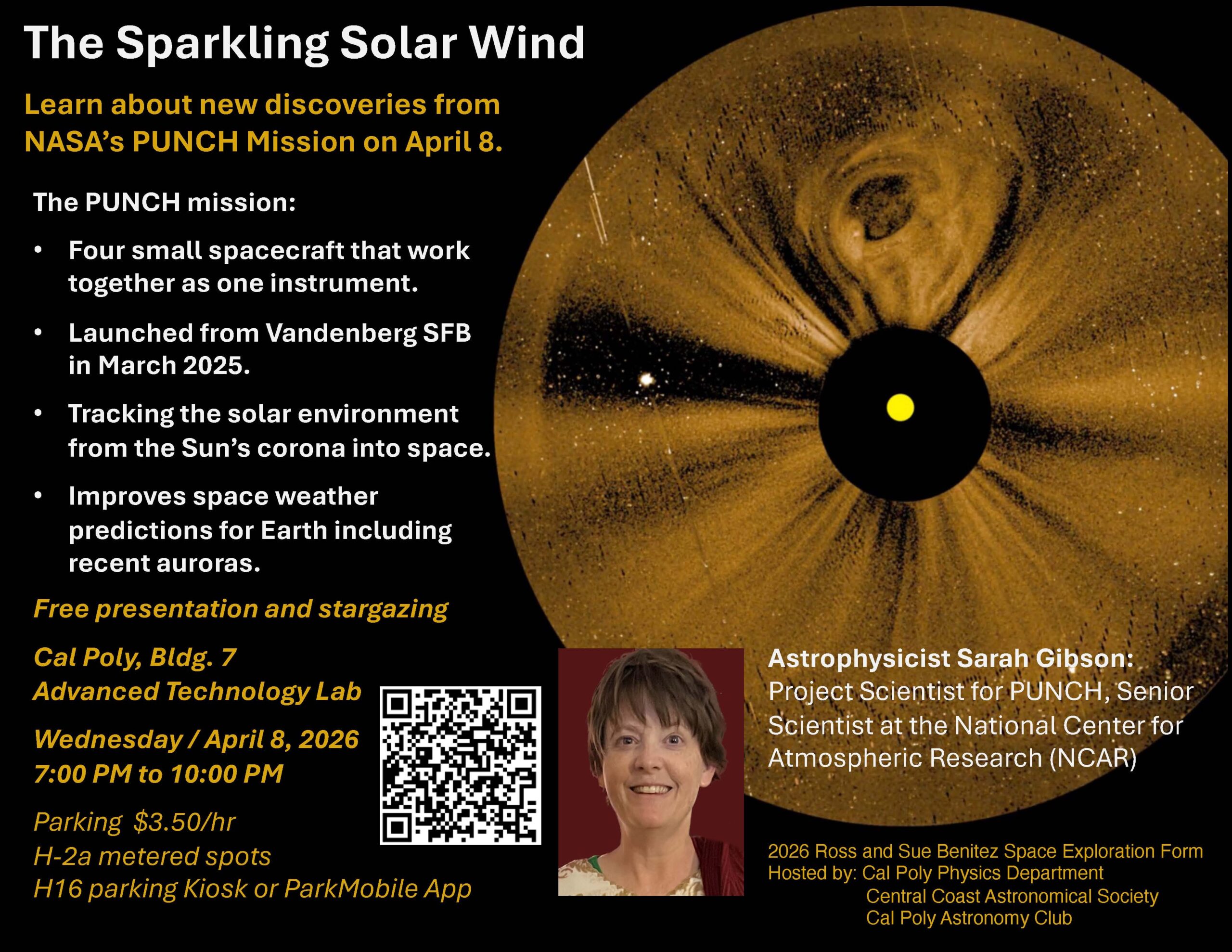
In this talk, Dr. Sarah Gibson will explore PUNCH’s first images, how they are changing our understanding of solar storms, and why auroras have been appearing more frequently around the world. This is a rare opportunity to see the Sun not as a static disk, but as a dynamic, living system that directly affects Earth and our technology.
Dr. Gibson is a Project Scientist for NASA’s PUNCH mission, a Senior Scientist at the National Center for Atmospheric Research’s High Altitude Observatory, and an internationally recognized leader in solar and heliospheric physics. Whether you’re a longtime observer or simply curious about our place in the solar system, this presentation offers a fascinating look at cutting-edge space science in action.
Wednesday, April 8th from 7-10pm
at the Advanced Technologies Lab (Building 7), Cal Poly
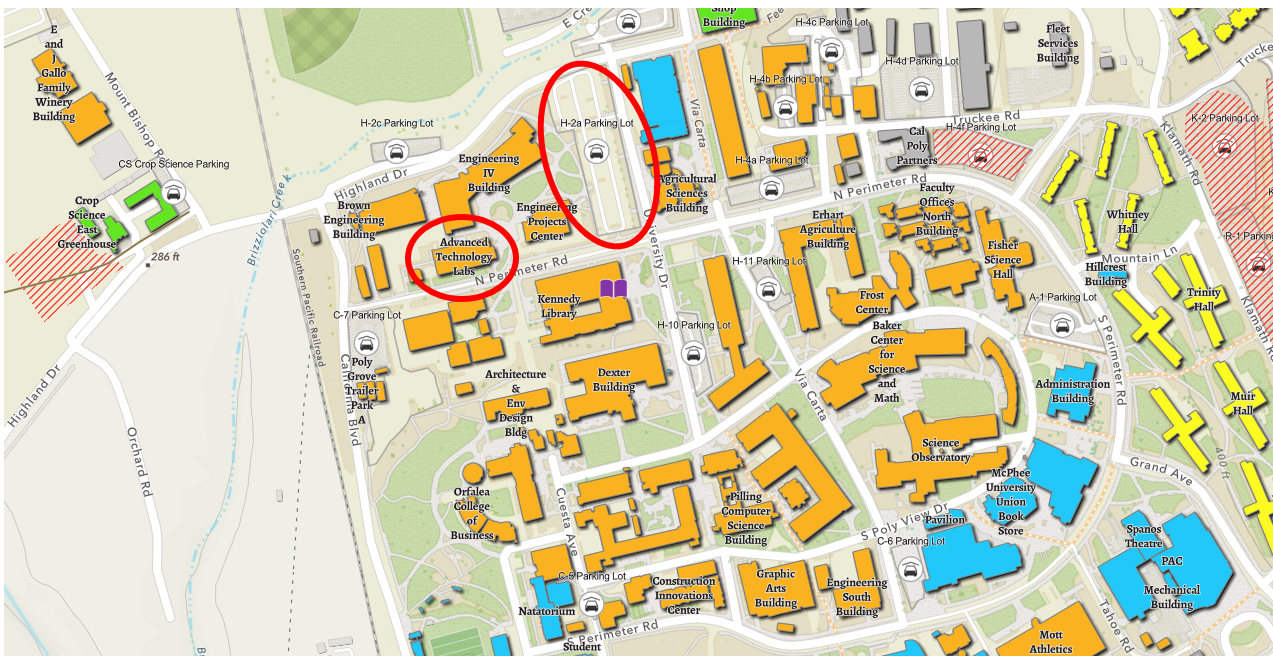
This will be a fascinating evening for anyone curious about how the Sun drives space weather, how scientists study the solar wind, and how new missions like PUNCH are transforming our understanding of the Sun–Earth connection. All are welcome to attend. Parking ($4/hr) in H-2a (metered spots), H-12, H-16 lots (use the kiosk or ParkMobile App). Here is a parking map for quick reference. Click for more info on this event.
PUNCH is a new NASA space mission designed to help us understand how the Sun affects everything in the solar system, including Earth.
Instead of using one large spacecraft, PUNCH uses four small satellites flying together around Earth. Their job is to watch the Sun’s outer atmosphere and track how solar material flows outward to become the solar wind—the constant stream of charged particles that fills space and drives space weather.
By stitching together images from all four satellites, PUNCH creates wide, 3D views that show how solar storms form, move, and spread through space. This helps scientists better understand events that can cause auroras, disrupt satellites, affect GPS and communications, and impact power grids on Earth.
In short, PUNCH lets us see how the Sun connects to Earth in real time, turning invisible space weather into something we can finally watch and study.