Go look at Venus on March 24th!
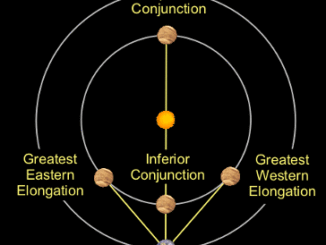
Venus is going to be at greatest elongation and will be shining brightly in the sky. Here’s information on how and where to look!
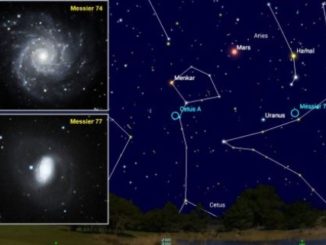
Every year around the new-moon weekend in March, amateur astronomers challenge themselves with this fun )and now a lot easier to do!) Messier Marathon that you can do nearly completely with just a set of binoculars, dark skies, and a good stargazing app with some practice ahead of time.
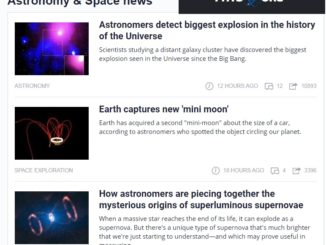
There’s a lot of great places to get real in-depth news about current research and breakthroughs. Here’s one that you might have missed – Phys.org They have an entire section dedicated just to Astronomy and Space news that is actually quite popular.
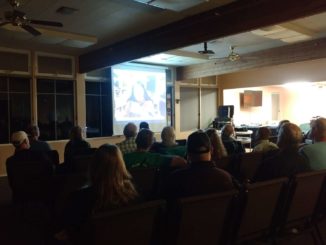
We had a full house (over 50 people in attendance) for our February guest speaker, Dr. Pamela Gay from CosmoQuestion and her 500+ episodes of AstronomyCast. During her presentation. Pamela had several suggestions about how to help our astronomers with doing their science, and I wanted to compile her information [Read More…]
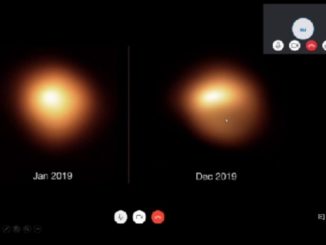
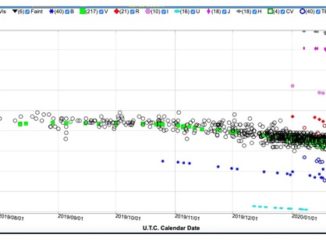
Betelgeuse is classified as a Semi-Regular variable with a period of about 423 days and brightness range from visual mag 0 to mag 1.6. Like all Semi-Regulars the period and both maximum and minimum brightness levels are subject to fluctuations cycle to cycle. This cycle the star dimmed more than [Read More…]
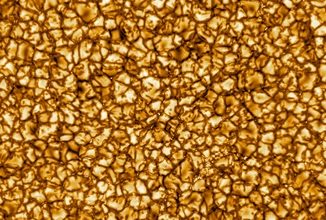
This is an amazing feat of engineering! This telescope looks at the sun in a special way – by rotating the 150-ton platform that has all the scientific instruments on it in order to counteract the apparent rotation of the sun that we see from Earth.
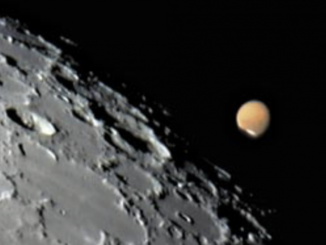
This image is on July 17, 2003, and it’s the occultation of Mars by the moon! Wow, right?? It’s going to happen again on next Tuesday morning before dawn, but don’t expect Mars to appear this amazing, even through the telescope. Back in 2003, Mars was only 0.48 AU from [Read More…]
Stargaze with us on Feb 15th! Nothing is more romantic than a dark, star-studded sky, and our happy astronomers are doing all the hard work and heavy lifting! We’ll be at the Santa Margarita Lake at sunset with our big telescopes and hope you’ll join us! (Hint: our astronomers love [Read More…]
Mercury is going to be at greatest elongation on Feb. 10th – go outside and look for a low, bright spot near the horizon. Click to read more!
It’s easy to do real hands-on science to teach yourself to learn the night sky! Astronomy is an amazing way for you to learn about science and astronomy since it includes so many different areas as well: geometry (where did that planet go?), algebra (how far is that planet?), cartography [Read More…]
Copyright © 2026 | WordPress Theme by MH Themes